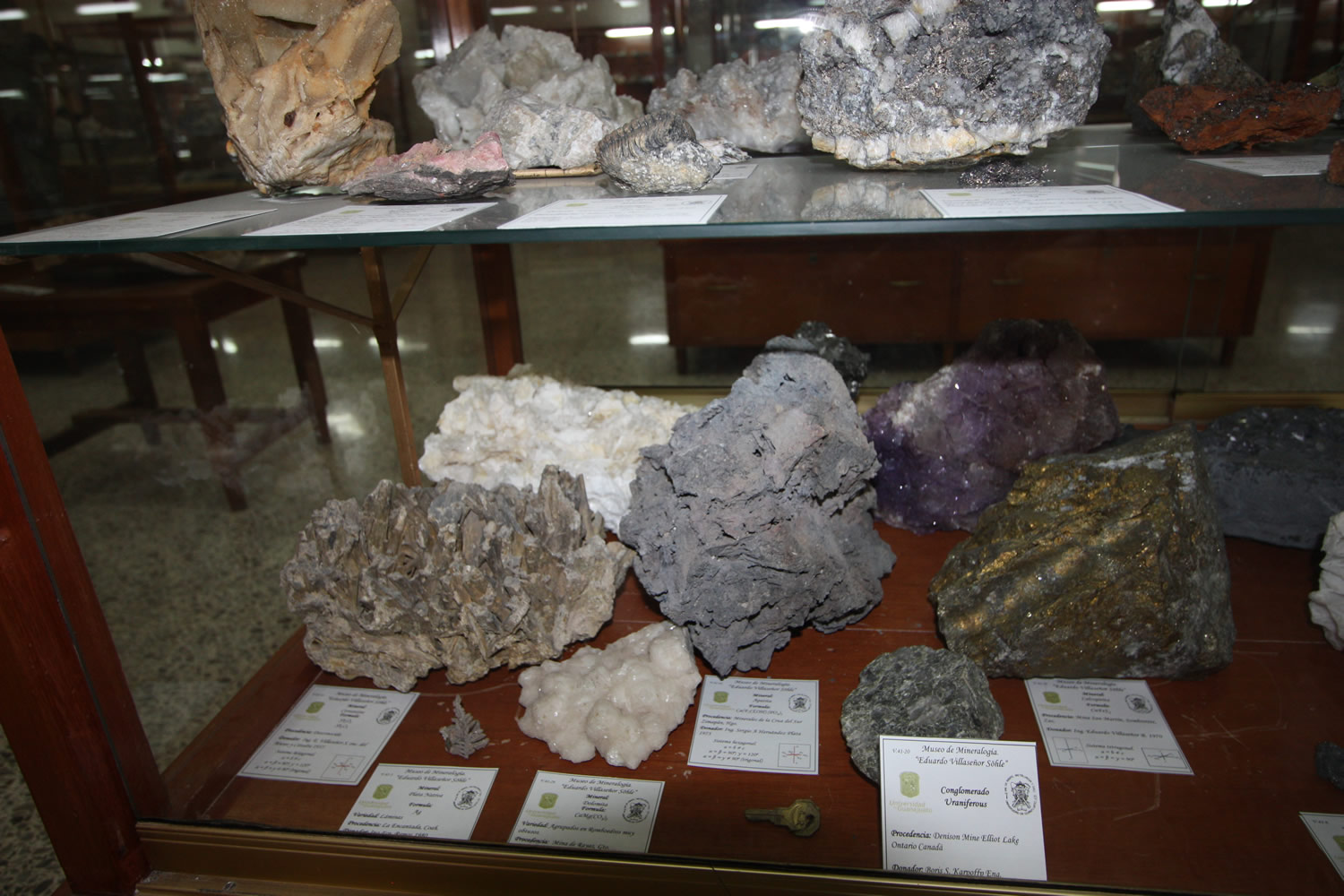
 Guanajuato, Gto., July 16, 2017.- More than 24,000 pieces of unbelievable beauty can be appreciated for free in the Mineralogy Museum "Ingeniero Eduardo Villaseñor Sohle" of the University of Guanajuato (UG), located in the venue San Matías of the Division of Engineering of Campus Guanajuato.
The engineer Juan Esteban García Dobarganes Bueno, Director of the Department of Mines, Metallurgy and Geology of the Division of Engineering (DI), invited people of Guanajuato and national and foreign visitors, to be awed with the stupendous collections of the museum, which is open from Monday to Friday, however, they have plans to open all week to attend tourism.
He commented that the visitor will find a large quantity to displays with nearly 24,000 specimens and sections with specific collections, the largest, of Don Ponciano Aguilar.
The samples are important not only for their incredible beauty and shapes, he said, but because their crystalline systems were formed by the own nature, by earth.
There are some delicate ones, he revealed, such as the completely crystalline "plasters" which are famous for the "sword grotto" of the Naica mine, Chihuahua; which has been object of international over stories and, from there, in the Museum of Mineralogy there are some "small" specimens, compared to the giants there with are 8m or 7m.
García Dobarganes mentioned that the specimens are worth much more for what they represent, for their beauty and for their crystallization form, than for the mineral they have.
They have important pieces because they were collected in the ancient mineral bodies of the mines of Guanajuato that don't exist anymore, you cannot rebuild history of that deposit than for the samples they have, for example, the mine of Light or the ancient places of Rayas. There are samples of silver, gold, calcite, plaster, quartz, selenite, aguilarite, among others.
The museum has samples of the Mining District of Guanajuato from all its mines, he said, but also from around the country and some from abroad. Likewise, in the museum's lobby you can observe some "volcanic bombs" which acquire their shape by spinning in the atmosphere, most of them are from Valle de Santiago.
They also have a fragment of the Allende meteorite, which was dated in an age of 4,500 million years, which is no less that a piece of the primitive material of what it was supposed to be the solar system.
It is worth to mention that within the Museum of Mineralogy, the collection of Don Ponciano Aguilar, has 9,000 examples donated by her daughter María Aguilar Zavaleta to UG in 1942.
Ms. Aguilar referred in her donation that: "most part of the examples is important (they are) gold and silver, among them is the rare and appreciated aguilarite species". Being a superintendent of the San Carlos mine, on the mother vein, near the mine of Rayas, Don Ponciano discovered a new mineral, to which he defined as silver sulfoselenide.
Don Ponciano provided several examples of this species to a collector, who gave one of those to the outstanding American mineralogist Genth (1891) who reported it as a new mineralogic species with the name aguilarite, in honor of who discovered it.
If you're interested in visiting the Museum, for free, you can go from 8am to 4pm in the San Matías Ex Hacienda no number in the San Javier zone, from Monday to Friday.
Photo Gallery